
eNutritionFacts
  • Nutrition Topics
    • Food & Drink Nutrition Facts
    • Nutrition Label Guides
    • Preparation Impact
    • Clean Label & Ingredients
  • About Us
    • Our Story & Mission
    • Expert Team
  • Editorial Standards
    • Editorial Guidelines & Fact-Checking Policy
    • Nutrition Data Methodology
  • Nutrition Lookup
  • Contact
Recent Posts
  • Raw Spinach Nutrition Facts
  • Eggs Nutrition Facts
  • Apple Nutrition Facts
  • Banana Nutrition Facts
  • What Does Added Sugar Mean on a Nutrition Label?
  • What Does Percent Daily Value Mean on a Nutrition Label?
  • What Does Serving Size Mean on a Nutrition Label?
  • How to Read Nutrition Facts Labels
  • What Are Ultra-Processed Foods? The NOVA Classification Explained
  • Raw vs Cooked Spinach Nutrition Facts

Categories

  • Clean Label & Ingredients
  • Food & Drink Nutrition Facts
  • Nutrition Label Guides
  • Preparation Impact
eNutritionFacts
eNutritionFacts
  • Nutrition Topics
    • Food & Drink Nutrition Facts
    • Nutrition Label Guides
    • Preparation Impact
    • Clean Label & Ingredients
  • About Us
    • Our Story & Mission
    • Expert Team
  • Editorial Standards
    • Editorial Guidelines & Fact-Checking Policy
    • Nutrition Data Methodology
  • Nutrition Lookup
  • Contact
Zuppa Toscana Nutrition Facts
  • Nutrition Label Guides

Zuppa Toscana Nutrition Facts That Will Blow Your Mind!

  • October 10, 2024
  • Fernando Filipe

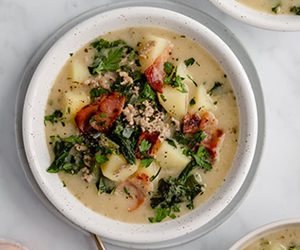
Zuppa Toscana is one of those dishes that seems innocent enough. A hearty soup, bursting with Italian flavors—what could be more comforting? But here’s where it gets interesting: the nutrition facts of Zuppa Toscana will absolutely blow your mind. For something that feels so rustic and simple, this soup packs in a lot more than you might think, and not necessarily in the way you’d expect.

Let’s break it down. Most people who’ve indulged in this creamy, savory delight know it’s more than just a light appetizer. It’s the kind of soup that clings to your ribs, leaving you full for hours. And that’s largely because Zuppa Toscana is rich. We’re talking about a soup loaded with ingredients like Italian sausage, bacon, heavy cream, and potatoes, all swimming in a comforting broth. That combo alone should give you a hint that we’re not dealing with a “low-cal” option here.

On average, a typical bowl of Zuppa Toscana—about 1 ½ cups—delivers around 400 to 500 calories. Yup, one bowl can easily match an entire meal’s worth of calories. And it doesn’t stop there. The sausage and bacon push the fat content to the higher end too, averaging anywhere between 30 to 35 grams of fat per serving, with about 15 grams being saturated fat. If your jaw just dropped, I get it. Zuppa Toscana isn’t exactly what you’d call “diet food.”

But let’s not villainize fat. Fat, after all, is necessary. It’s what gives the soup its rich flavor and creamy texture. The carbohydrate count in a bowl of Zuppa Toscana can hover around 20 to 25 grams, mainly coming from the potatoes. And while potatoes often get a bad rap in low-carb circles, they do bring some nutrients to the table. You’ll get a decent amount of vitamin C and potassium from them, which balances the indulgence a bit. Still, if you’re watching your carbs, this might not be your go-to.

Now, here’s where Zuppa Toscana really hits hard—sodium. If you’ve ever eaten this soup and wondered why you were chugging water afterward, it’s because a serving can have 1,000 to 1,200 milligrams of sodium. That’s nearly half of your recommended daily intake, in just one bowl! The sausage, bacon, and broth all contribute to this sodium overload, so if you’re sensitive to salt, this is something to seriously consider before diving in.

But it’s not all doom and gloom. Zuppa Toscana does have some redeeming qualities that might make you feel a little better about indulging. For one, it’s got protein. Thanks to the sausage, bacon, and cream, you’re looking at about 15 to 20 grams of protein per serving. That’s more than a lot of soups out there, and it’s part of why you feel so full after eating it. And let’s not forget the kale! The addition of kale provides a dose of fiber and a ton of vitamins—particularly vitamin A, K, and C—which adds a small health halo over this otherwise indulgent dish.

Click here to preview your posts with PRO themes ››

So where does that leave us? Zuppa Toscana is a soup of contradictions. It’s comforting, hearty, and flavorful, but it also sneaks in a heavy load of calories, fats, and sodium. If you’re trying to stick to a healthier eating plan, it might not fit neatly into your daily goals. But here’s the thing—food is meant to be enjoyed, and Zuppa Toscana, with all its richness and flavor, deserves to be savored. Just maybe not every day, unless you’re ready to tackle those nutrition facts head-on.

If you’re in the mood to indulge, a homemade version might be your best bet. You can tweak the recipe to your liking, swapping out heavy cream for something lighter, or using turkey sausage instead of pork. Adding more kale or other vegetables can boost the fiber content, making it a bit more balanced. And trust me, you can still get all that satisfying flavor with these small adjustments.

At the end of the day, Zuppa Toscana is more than just a bowl of soup. It’s an experience, a comfort, and sometimes, a little bit of an indulgence. Knowing the nutrition facts might give you pause, but that doesn’t mean it can’t be part of your food repertoire. Just be mindful of what’s in that bowl—and maybe take it easy on the second serving!

Related Topics
  • ComfortFood
  • FoodFacts
  • HealthyEating
  • ItalianSoup
  • NutritionFacts
  • SoupLovers
  • Zuppa Toscana Nutrition Facts
  • ZuppaToscana
Fernando Filipe
Fernando Filipe

Owner, Chief Editor, and Registered Dietitian at eNutritionFacts.com. Fernando Filipe leads the platform’s editorial strategy and nutrition standards, helping translate complex food, nutrition-label, and dietary science topics into accurate, accessible, and data-informed content. His work focuses on editorial integrity, source transparency, and practical nutrition education. Read full author profile

Previous Article
impossible whopper
  • Nutrition Label Guides

Unwrapping the Nutritional Secrets of the Impossible Whopper

  • March 8, 2024
  • Fernando Filipe
Read More
Next Article
buldak ramen nutrition facts
  • Nutrition Label Guides

Buldak Ramen Nutrition Facts: The Spicy Truth About Your Favorite Meal

  • October 10, 2024
  • Fernando Filipe
Read More

Leave a Reply Cancel reply

Your email address will not be published. Required fields are marked *

Latest Nutrition Guides

enutritionfacts_label

Raw Spinach Nutrition Facts

Source-backed raw spinach nutrition facts with calories, macros, per 100g values, serving-size data when available, FDC ID 168462, and USDA...

enutritionfacts_label

Eggs Nutrition Facts

Source-backed eggs nutrition facts with calories, macros, per 100g values, serving-size data when available, FDC ID 748967, and USDA FoodData...

enutritionfacts_label

Apple Nutrition Facts

Source-backed apple nutrition facts with calories, macros, per 100g values, serving-size data when available, FDC ID 2709215, and USDA FoodData...

enutritionfacts_label

Banana Nutrition Facts

Bananas are one of the most commonly searched fruits for calories, carbohydrates, natural sugars, fiber, and potassium. This page summarizes...

Generic nutrition facts label with sugar spoon and checklist for added sugar comparison

What Does Added Sugar Mean on a Nutrition Label?

Added sugar on a Nutrition Facts label refers to sugars added during food processing or preparation. It is listed separately...

Generic nutrition facts label with checklist for Percent Daily Value comparison

What Does Percent Daily Value Mean on a Nutrition Label?

Percent Daily Value, often shown as %DV, helps explain how much a nutrient in one serving of food contributes to...

Generic food package with nutrition facts label beside measuring tools for serving size comparison

What Does Serving Size Mean on a Nutrition Label?

Serving size is the amount of food or drink used as the basis for the Nutrition Facts label. Calories, nutrients,...

Generic packaged food with nutrition facts panel and ingredient list for label reading

How to Read Nutrition Facts Labels

Nutrition Facts labels can look simple at first, but they contain several pieces of information that need to be read...

About eNutritionFacts
About Us
Our Expert Team
Contact
Sitemap
Editorial Standards
Editorial Guidelines
Nutrition Data Methodology
Expert Review Policy
Corrections & Updates Policy
Legal & Disclaimers
Medical Disclaimer
FTC & Affiliate Disclosure
Privacy Policy & Cookie Policy
Terms of Use
eNutritionFacts

© 2026 eNutritionFacts. All rights reserved. eNutritionFacts is owned and operated by FFMarketing.

Content on this site is provided for educational and informational purposes only and is not medical advice. eNutritionFacts may earn revenue from display ads, affiliate links, sponsored placements, or other commercial relationships. These relationships do not control our nutrition data, editorial standards, review policies, or correction decisions.

Input your search keywords and press Enter.